<?xml version="1.0" encoding="ISO-8859-1"?>
<rdf:RDF xmlns:rdf="http://www.w3.org/1999/02/22-rdf-syntax-ns#" xmlns:ref="http://purl.org/rss/1.0/modules/reference/" xmlns:dc="http://purl.org/dc/elements/1.1/" xmlns="http://purl.org/rss/1.0/">
	<channel rdf:about="http://davidhusom.com/pblog/rss.rdf">
		<title>David Husom Photographer</title>
		<link>http://davidhusom.com/pblog/index.php</link>
		<description><![CDATA[davidhusom.com]]></description>
		<items>
			<rdf:Seq>
				<rdf:li resource="http://davidhusom.com/pblog/index.php?entry=entry100618-173520" />
				<rdf:li resource="http://davidhusom.com/pblog/index.php?entry=entry100116-140236" />
				<rdf:li resource="http://davidhusom.com/pblog/index.php?entry=entry100115-210724" />
				<rdf:li resource="http://davidhusom.com/pblog/index.php?entry=entry090905-123336" />
				<rdf:li resource="http://davidhusom.com/pblog/index.php?entry=entry090605-121957" />
				<rdf:li resource="http://davidhusom.com/pblog/index.php?entry=entry090308-133642" />
				<rdf:li resource="http://davidhusom.com/pblog/index.php?entry=entry090123-133124" />
				<rdf:li resource="http://davidhusom.com/pblog/index.php?entry=entry080731-212556" />
				<rdf:li resource="http://davidhusom.com/pblog/index.php?entry=entry080718-190431" />
				<rdf:li resource="http://davidhusom.com/pblog/index.php?entry=entry080416-141226" />
			</rdf:Seq>
		</items>
	</channel>
	<item rdf:about="http://davidhusom.com/pblog/index.php?entry=entry100618-173520">
		<title>Photography at the San Francisco Museum of Modern Art — SFMOMA</title>
		<link>http://davidhusom.com/pblog/index.php?entry=entry100618-173520</link>
		<description><![CDATA[I was excited to learn a few months back that 12 of my photographs had entered the San Francisco Museum of Modern Art (SFMOMA) permanent collection. The images from both the fairground series, and more recent work on the Mississippi river towns of Wisconsin and Minnesota, were originally part of the Bruce and Nancy Berman collection and were a gift to the museum. <br /><br />I was in the Bay area last week and paid a visit to the new home for some of my favorite photographs, and was humbled to see that they will be in good company. There are currently two exhibits at the museum. Both contain some truly great photographs by some of my favorite photographers.  <br /><br />The first exhibit <a href="http://www.sfmoma.org/view/page.theme/anniversary" target="_blank" > 75 Years Looking Forward </a> features an overview of the SFMOMA collection, as well as a look at some of the exhibits and directions the museum has gone in the past 75 years. It was good to see a modern museum willing to look back, and particularly interesting to have it acknowledge its history as a design museum as well. Outside of MOMA in NY, most contemporary art museums ignore the rich history of design they displayed once upon a time (I mean you WAC). The display of portable Olivetti typewriters was particularly touching given the area&#039;s history of killing off the once ubiquitous writing instrument. A room full of anonymous photographs and the history of wooden chairs was also an interesting stop along the way. But what was particularly good news was to see photography given its full credit by being intermixed with the paintings and sculptures. At last a contemporary museum that understands photography&#039;s place in the art world! Something that one can not find very often here in the midwest. <br /><br />But wait, that is not all! The history of California photography was also featured in the exhibit <a href="http://www.sfmoma.org/exhibitions/403" target="_blank" >The View From Here</a>. It has long been obvious that CA has played a major role in the 20th century development of the medium. But I have admit that I was still surprised at how often I came across images that I showed in the classroom, when I taught photography history as part of darkroom photo courses. Sure there was Adams, Weston, Cunningham and Lange and the usual suspects. But the 13 print panorama by Eadweard Muybridge of SF in 1878 held up every bit as well as anything done in the 130+ years since. The final room featured work from the past decade, and I have to admit the one digital camera image in the show did lack something besides film grain. I think digital is still in its early stages and it might be a while before it can excite us as much as an albumen print from a glass negative by a master like Muybridge. <br /><br />Of course I post here a digital camera shot of a photographer on the upper floors looking down on the lobby. It truly is a wonderful museum. I can not wait to go back. <br /><br /><a href="javascript:openpopup('images/sfmoma.jpg',1018,800,false);"><img src="images/sfmoma.jpg" width="509" height="400" border="0" alt="" id="img_float_right" /></a><br />Photography Copyright © David Husom 2010. All rights reserved. Click to see larger.]]></description>
	</item>
	<item rdf:about="http://davidhusom.com/pblog/index.php?entry=entry100116-140236">
		<title>Book of Japan Photographs - Izu Shimoda Japan 1984 </title>
		<link>http://davidhusom.com/pblog/index.php?entry=entry100116-140236</link>
		<description><![CDATA[<a href="javascript:openpopup('images/Izu.jpg',403,320,false);"><img src="images/Izu.jpg" width="252" height="200" border="0" alt="" id="img_float_right" /></a> In 1984 we spent about a year living in the town of Shimoda Japan. Located about 3 hours from Tokyo, the town is a well known hot spring spa and beach resort area, but also a rice farming and fishing village. At the time it also had a very active shipyards. I spent almost every day photographing the town and the countryside around Shimoda. Being away from major cities and professional photo labs I decided to primarily work in black and white, although I had been working exclusively in color for about seven years at that point. But like my earlier color work I used a 4X5 Sinar camera for all of my photography. I processed the film and made contact prints while in Japan and larger fiber based prints back at our studio, then located in St. Paul. <br /><br />I had a show of the images in 1985 at Film in the Cities in St. Paul Minnesota with Stephen Shore (his of course were his American images and were color photographs) and a show in Japan later that same year with my wife Ann-Marie Rose, hers being hand colored black and white and shot with an 8X10 camera. <br /><br />I had not forgotten about the work, and in fact my office in our studio hangs work from that series. But given that it has been 25 years I decided to do a short run small book of 25 of my favorite photos from that project. Click on the image above right to see the cover. The book is available on Lulu at:<br /><br /><a href="http://www.lulu.com/content/lulustudio-photo-book/izu-shimoda-japan-1984/7614893" target="_blank" >Izu Shimoda 1984 Book by David Husom</a> You can preview all 25 photographs here as well as order a copy of the book. ]]></description>
	</item>
	<item rdf:about="http://davidhusom.com/pblog/index.php?entry=entry100115-210724">
		<title>International Border Minnesota and Canada at Lake of the Woods</title>
		<link>http://davidhusom.com/pblog/index.php?entry=entry100115-210724</link>
		<description><![CDATA[<a href="javascript:openpopup('images/marker.jpg',800,600,false);"><img src="images/marker.jpg" width="200" height="150" border="0" alt="" id="img_float_right" /></a> Minnesota has a small bump at the top where the US - Canadian border extends beyond the normal 48th parallel that divides the two countries. This is due to a 19th Century dispute over where the true source of the Mississippi was and the fact that the US wanted access to Lake of the Woods. It is the most northern point in the lower 48 (contiguous) states. To get here you leave the US in Roseau MN and drive through Canada for about an hour. When you cross from Canada back into Minnesota along the dirt road that leads into the Northwest Angle here is the border maker. Note the cut in the trees running north behind the marker showing the border. (Don&#039;t forget to check back in with US Customs at one of the remote border stations via video phone). <br /><br />Click on the image to see a larger version. Photograph Copyright David Husom 2009 All rights reserved. <br /><br /><a href="javascript:openpopup('images/cut.jpg',800,600,false);"><img src="images/cut.jpg" width="200" height="150" border="0" alt="" id="img_float_right" /></a> Once you get to the town of Angle Inlet (to call it a town is a stretch—but it does contain a post office and a store), you find about a half a dozen resorts. Drop your boar into Lake of the Woods at any of the boat ramps and head back west to the point where the inlet becomes an unnamed creek and you are at the true most northern point of Minnesota and the contiguous states. From out in the water looking back south at the border you see the clear cut line that runs the length of the US-Canadian border in the Northwest Angle. To the right is Manitoba, to the left is Minnsota. <br /><br />Click on the image to see a larger version. Photograph Copyright David Husom 2009 All rights reserved. <br /><br /><br /><a href="javascript:openpopup('images/spot.jpg',800,600,false);"><img src="images/spot.jpg" width="200" height="150" border="0" alt="" id="img_float_right" /></a> Here is the actual spot or tripoint where Minnesota, Manitoba and Ontario Canada meet. The exact spot is under water, but there have been markers nearby on the land at various times. Even in high water it is very shallow and weedy here. But according to our GPS, this is the point. Turning back around the clear cut in the tres (above) is very obvious. For such an important point, it is all very insignificant looking. But it is a spot we do like to visit every few years. If nothing else it is a bit of a challenge to get here. <br /><br />Click on the image to see a larger version. Photograph Copyright David Husom 2009 All rights reserved. <br /><br />And here is a Flip Video from YouTube showing the same spot. Note the cut line at the very end of the clip. Video Copyright David Husom 2009 All rights reserved.  <a href="http://www.youtube.com/watch?v=ibIKLuBBHPk" target="_blank" >Watch Video</a> <br /><br />]]></description>
	</item>
	<item rdf:about="http://davidhusom.com/pblog/index.php?entry=entry090905-123336">
		<title>Studio Ramble 2009</title>
		<link>http://davidhusom.com/pblog/index.php?entry=entry090905-123336</link>
		<description><![CDATA[<a href="javascript:openpopup('images/ramble09.jpg',520,798,false);"><img src="images/ramble09.jpg" width="195" height="300" border="0" alt="" id="img_float_left" /></a> <br />Our studio will once again be part of the Mississippi River valley fine art tour. Called the Studio Ramble, this is the 8th year for the tour. I will have some new work and some new projects to show. If you missed the Anderson Center show <i>American Heartland</i> last winter much of that work on display. My co-exhibitor Bill Rodman from that show will be showing his work here at our studio as well. Stop by on Sept 19th or 20th between 10:00 and 5:00.<br /><br />This years poster and brochure features one of my recent photographs from Arnold&#039;s Amusement Park in Okoboji IA. Click on the image on the left to see a larger version. <br /><br />For more information and to download a map visit: <a href="http://www.studioramble.com" target="_blank" >www.studioramble.com</a>]]></description>
	</item>
	<item rdf:about="http://davidhusom.com/pblog/index.php?entry=entry090605-121957">
		<title>Helping Pick Minnesota’s 10 Most Endangered Buildings.</title>
		<link>http://davidhusom.com/pblog/index.php?entry=entry090605-121957</link>
		<description><![CDATA[On a snowy day last winter I was invited to be meet with 9 others in the field of historic architecture to pick the ten most endangered buildings in the state. The panel included architects, an anthropologist, architectural historian, representatives from the Minnesota Historical Society and the Preservation Alliance of Minnesota<br /><br />It was actually a much more serious and engaging day than I would have expected. Although each of the possible structures had gone through a fairly rigourous nomination process we had to weigh each one carefully to decide not just the worthiness of the entry, but also possible benefits from listing, and if the structure or similar ones had been listed recently. In the end we each picked one building or structure to write up a description of for press releases and the Web. Of course I could not pass up the chance to work on the wonderful fish shaped building in Bena MN. Featured in a number of books on roadside Americana and in the introduction to the Chevy Chase movie <i> National Lampoon Vacation</i> it is certainly a structure worth preservation. Let’s hope that the nomination encourages the owner, town and the powers that be to help keep this wonderful landmark of vernacular architecture in repair. <br /><br />Here is the full list for 2009: <a href="http://www.mnpreservation.org/programs/ten-most-endangered/" target="_blank" >www.mnpreservation.org/programs/ten-most-endangered</a><br /><br />As well as a great article from the Mpls Star Tribune about the list: <a href="http://www.startribune.com/local/44569787.html?elr=KArksUUUU" target="_blank" >www.startribune.com/local/44569787.html?elr=KArksUUUU</a><br /><br />And more on the Bena Fish: <a href="http://www.roadsideamerica.com/blog/fish-landmarks-on-land/" target="_blank" >www.roadsideamerica.com/blog/fish-landmarks-on-land</a><br />]]></description>
	</item>
	<item rdf:about="http://davidhusom.com/pblog/index.php?entry=entry090308-133642">
		<title>A Sinking Feeling About the Mississippi River Steamboats</title>
		<link>http://davidhusom.com/pblog/index.php?entry=entry090308-133642</link>
		<description><![CDATA[<img src="images/mississippi_queen.jpg" width="450" height="300" border="0" alt="" /><br />American Queen in Red Wing MN. Cell Phone Photograph ©2008 by David Husom<br /><br />Living near a historic river town and transportation hub like Red Wing Minnesota means there is never a shortage of arriving and departing boats and trains. The Amtrak makes a stop in the morning on its way to Chicago and again at night on it journey to St. Paul and beyond to the West Coast. In the summer the visits of the Delta Queen, Mississippi and American Queens may not bring out the crowds like the steamboats did back in the days of Mark Twain. However you can always count on a non-stop trickle of visitors to the docks when one of these wonderful ships makes an appearance. As of last fall the boats even used Red Wing as its upper Mississippi River terminus, forgoing St. Paul for the more inviting streets of Red Wing, and spending the night here. <br /><br />While traveling down the Mississippi River during its last voyage I grabbed a quick cell phone of the steamboat American Queen landing at the port of Red Wing. Looking at the photos recently I discovered that the combination of tipping the camera up to include the ship stacks, the motion of my boat heading the opposite direction, and the poor quality electronic shutter of my cell phone, gives the American Queen, the appearance that it is tipping and starting to sink (was this an omen?). The American Queen, like its sister ship, the famed Delta Queen, are awaiting sale as the owners struggle financially. As of a few days ago it was decided that the Delta Queen would spend the summer as a floating hotel in Chattanooga Tennessee. I guess that is better than being sold for scrap. But let us hope that all three of the riverboats return to the Mississippi waterways soon. <br /><br />For information on saving the historic Delta Queen visit:  <a href="http://www.save-the-delta-queen.org" target="_blank" >www.save-the-delta-queen.org</a><br />]]></description>
	</item>
	<item rdf:about="http://davidhusom.com/pblog/index.php?entry=entry090123-133124">
		<title>American Heartland Exhibit at Anderson Center</title>
		<link>http://davidhusom.com/pblog/index.php?entry=entry090123-133124</link>
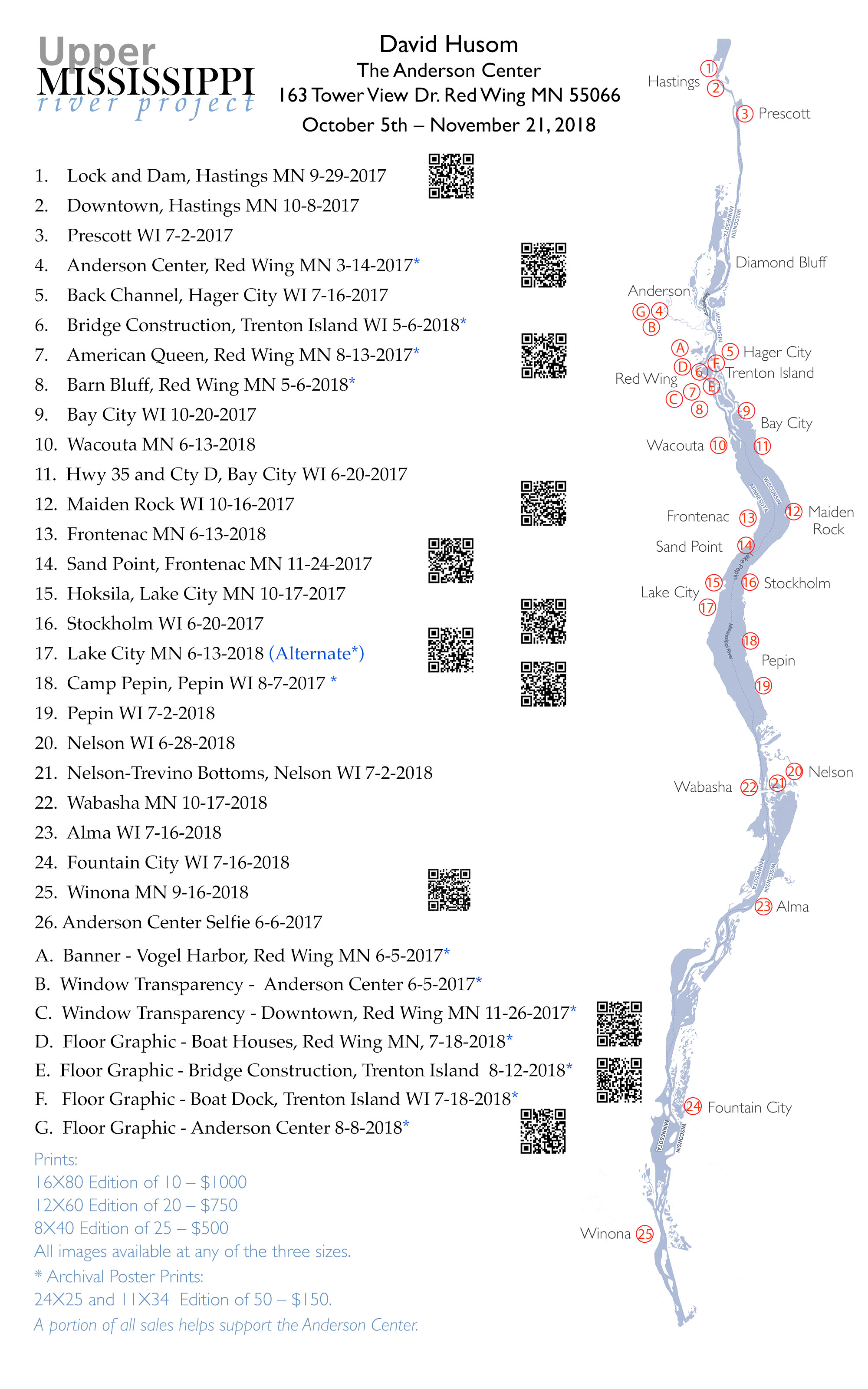
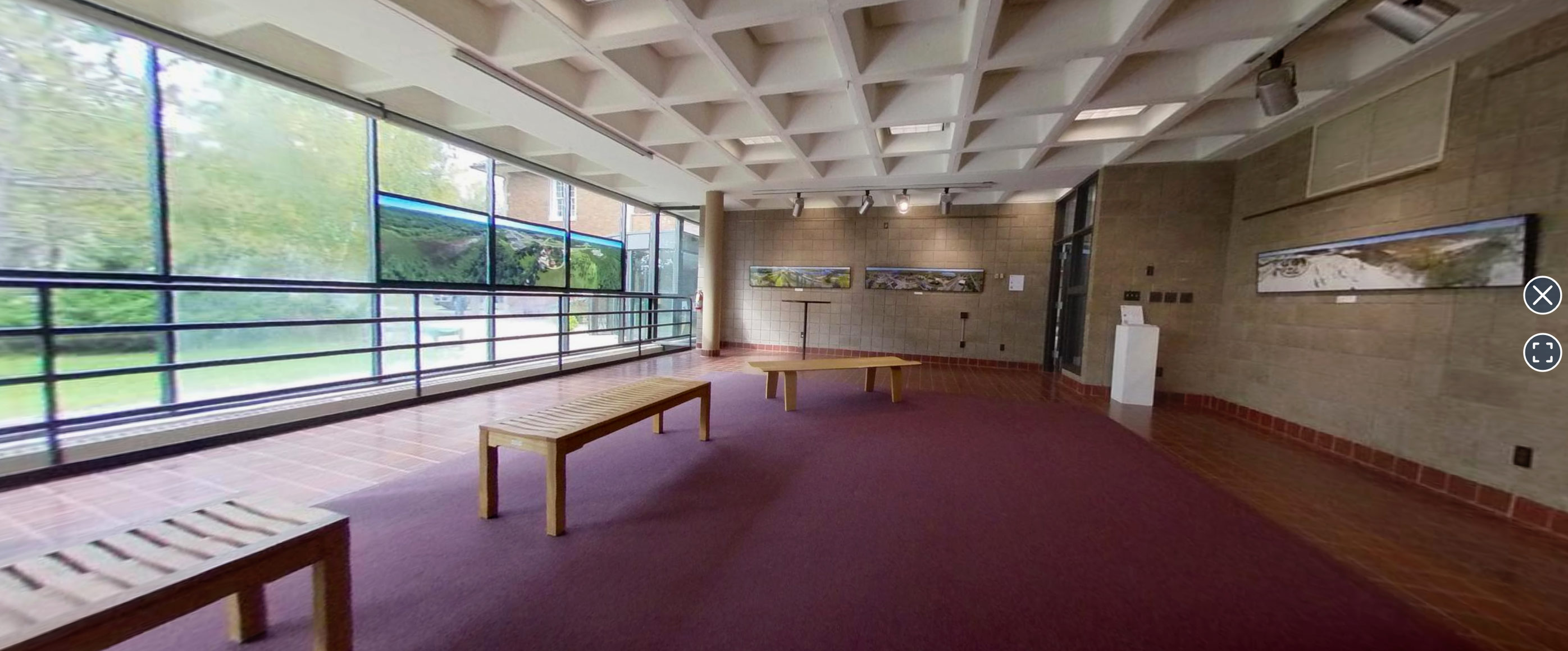
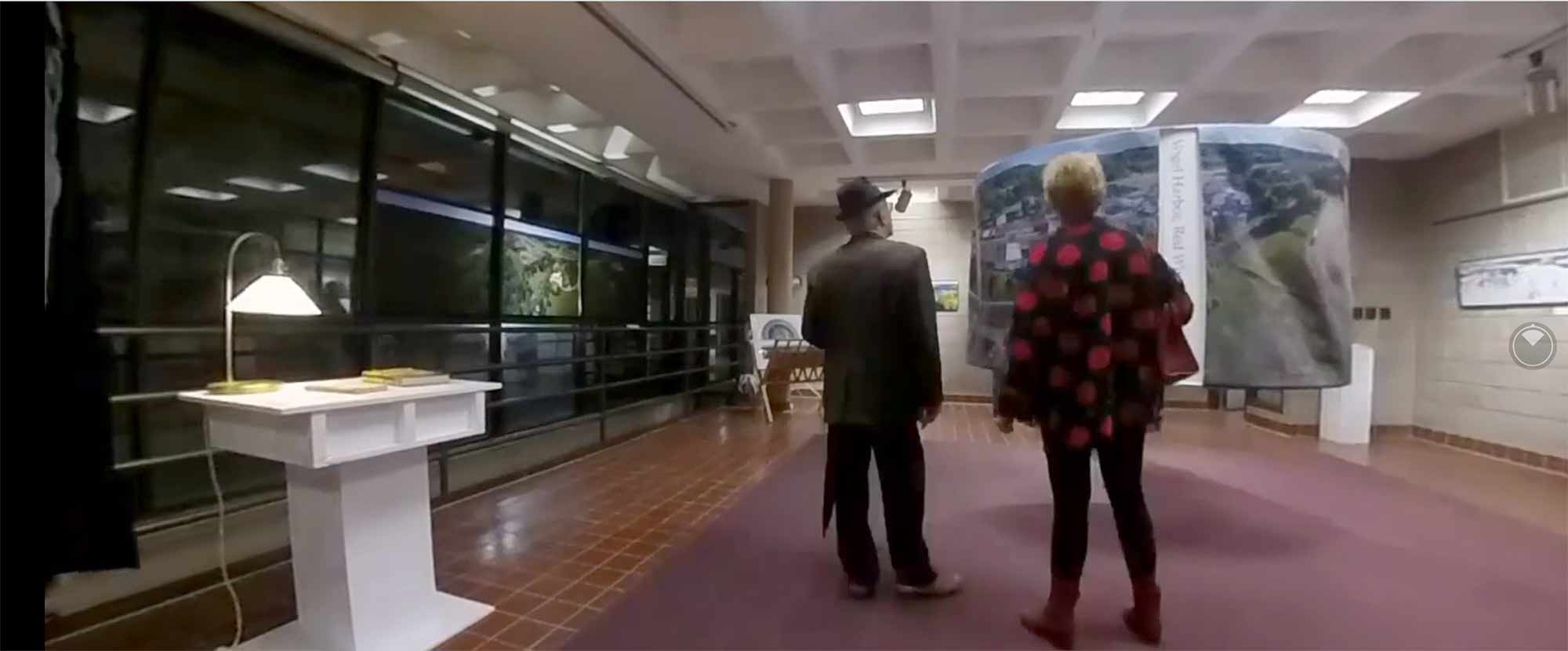
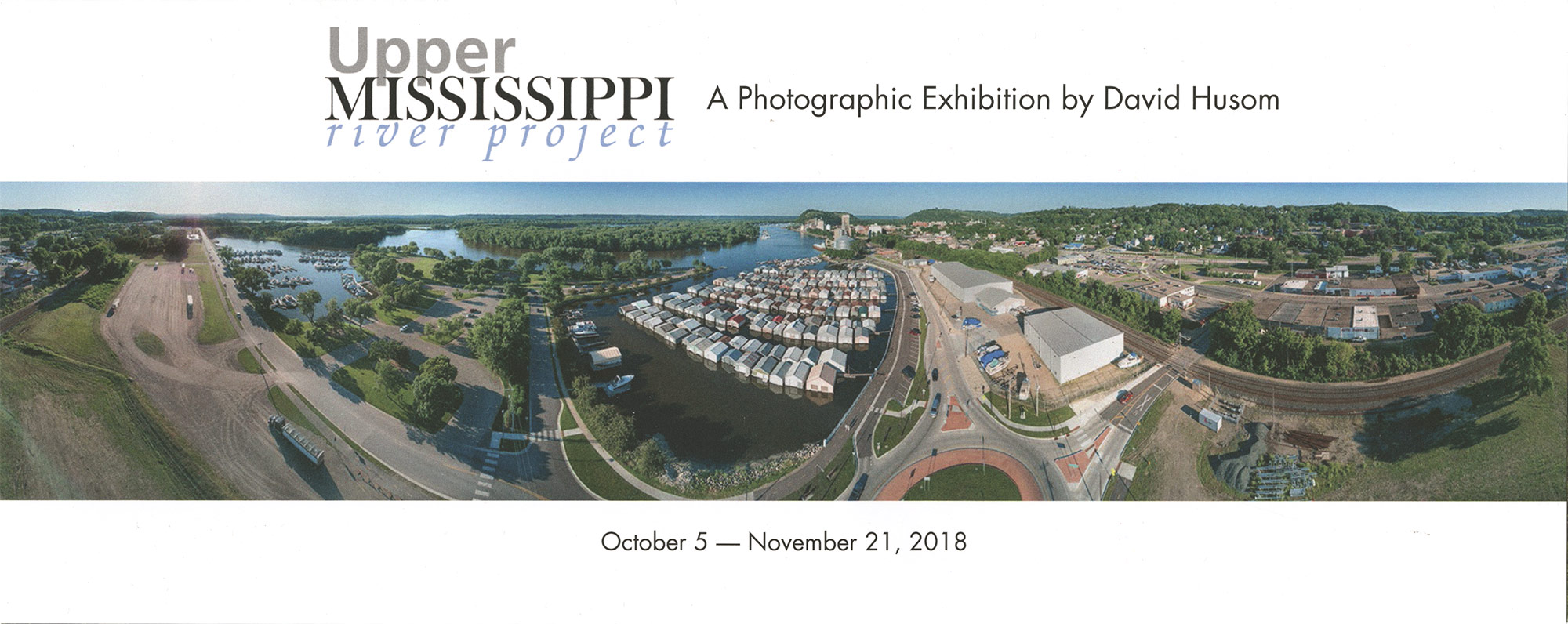
		<description><![CDATA[ <a href="javascript:openpopup('images/anderson_ctr.jpg',600,400,false);"><img src="images/anderson_ctr.jpg" width="200" height="133" border="0" alt="" id="img_float_left" /></a> Photographs I have taken in Southeastern Minnesota and Western Wisconsin over the past 5 years are now on exhibit at the Anderson Center in Red Wing MN. The exhibition, titled <i>American Heartland</i>, is a two person exhibit with William Pringle Rodman. Rodman, a Minneapolis photographer,  has  been photographing in many of the same areas in Minnesota and Wisconsin during the past few years. All of the photographs in the exhibit were made with film. I shoot 4X5 color but do make digital pigment prints. Bill Rodman shoots 35mm black and white film and makes conventional darkroom prints. <br /><br />The gallery is open 9-4 Mon -Thur and 9-12 on Fri. The show is up through March 13th. . <i>National Geographic Traveler</i> magazine recently named the Anderson Center, along with the Walker Art Center, Weisman Museum, Minneapolis Institute of Arts and Guthrie theatre as one of the five most important arts institutions in Minnesota. Click on the image above left to see a larger version of the exhibition announcement. See the <a href="http://www.andersoncenter.org/" target="_blank" >Anderson Center Website</a> for more information<br /><br /><a href="javascript:openpopup('images/opening-photo.jpg',700,328,false);"><img src="images/opening-photo.jpg" width="200" height="94" border="0" alt="" id="img_float_left" /></a> <br /><br />Photograph of the opening by Michael Lougee Copyright 2009. Click on the image on the left to see a larger photograph.  <br /><br /><br /><br />]]></description>
	</item>
	<item rdf:about="http://davidhusom.com/pblog/index.php?entry=entry080731-212556">
		<title>Minnesota Center for Photography RIP. But why? </title>
		<link>http://davidhusom.com/pblog/index.php?entry=entry080731-212556</link>
		<description><![CDATA[As is bring covered in both the Minnesota media and photo and art blogs across the country, the Minnesota Center for Photography closed its doors today. MCP began as pARTS, a small gallery above an auto body shop that had a certain charm in spite of its smelling like paint so bad you often felt you needed an oxygen mask to enter. It then moved to a basement on Lake Street and eventually became MCP. A third move took them to a beautiful gallery in a former photo studio in the up and coming art neighborhood of Northeast Minneapolis. For the sake of full disclosure I will say I was in a group show at each of the first and second locations, and taught two classes in the darkroom during their first year at the final location.  I never had any official connection to the organization however, so these are my own thoughts as a former Minnesota photographer who now lives nearby in Wisconsin (and since I am ineligible for most of the benefits of the MN fine art photo world, I am just an innocent bystander— but, with a bit of history).<br /><br />Although the closing is being presented as a surprise by some, rumors have been circulating for months. And although it is being presented as a sign of the economy or lackluster fundraising, the rumors have pointed to excessive spending, using operating budget funds for programing, staff conflict (that one is at least 10 years old however), overly ambitious shows of international photography (the recent Three Gorges China show is often mentioned), or the move to the more expensive space four years ago. However, I think there was a bigger problem—lack of support from the Minnesota photo community. <br /><br />News reports point to the broad based support MCP had in the community, however discussions I have had over the years with board members and staff have pointed to the opposite. On a couple of occasions in recent years I had sent students to events at MCP. When I asked their impressions, they invariably came back and reported the same thing: &quot;It was just a bunch of old people.&quot; I am reminded of a friend in Japan who used to say, in less than perfect English, &quot;It is the taste of old men.&quot; I know this was not just a MCP problem. At another arts institution in Minneapolis I had a friend approach me at an opening and exclaim: &quot;Photography is alive and well in Minneapolis, just look at the crowd here.&quot; I looked around, and upon not seeing anyone under 50 said: &quot;It may not be dead yet, but if you stand on your tiptoes you can see the end in this room.&quot; Where were the young photographers? I would guess they were just not very interested in much of what MCP had to offer, nor did they feel a part of it. Maybe if MCP had not turned its back on the young local photographers and paid so much attention (and money it seems) to out of town talent it would have gotten more support. <br /><br />A bigger issue however is that the Minnesota fine art photography scene has always had a heavy dose of animosity hanging in the air. This is another topic a board member and a former staff member told me in private. Some blame it on the perception of too much grant money going to the same few people. Or a variation on that, the same people being asked to show their work at invitational or &quot;juried&quot; shows—the MCP Photo Lotto / Bravo being a case in point for many in the community.  Others blame the lack of support for local artists from the Walker, or the second class status of local artists at the Minneapolis Institute of Art. Still others see the sometimes nasty competition between the University of Minnesota&#039;s Art Department and the Minneapolis College of Art and Design. The removal of the McKnight Grant from the U of MN and moving it to MCP also brought forth an attack of venom in the community over the past few years. (Again for disclosure, I did teach full time at the U of MN Art department, and classes and workshops at MCAD, but left them both over a dozen years ago. I also was in Photo Lotto / Bravo a few times, but not at the current location, and got my McKnight Grant back when Film in the Cities gave them out over 20 years ago). <br /><br />Is this problem just the way photographers are? According to a former staff member, and from what I have seen, the ill will of Minneapolis fine art photographers is not present in other cities; Los Angeles being a perfect example. Nor do I see it amongst the artists of out-state Minnesota or rural Wisconsin where I now live. In fact I see just the opposite; we all work together for the joint good of the local arts community. I certainly did not see problems amongst commercial  photographers in Minnesota when I was on the board of the Minnesota Commercial Industrial Photographer Association.  From photo journalists I also hear of the strong support they often give one another. So what is up with the Twin Cites fine art photographers? Maybe it is time to take a good hard look at WHY.<br /><br />Here are just a few of the stories:<br /><a href="http://www.minnpost.com/michaelmetzger/2008/07/31/2788/minnesota_center_for_photography_shuttered" target="_blank" >www.minnpost.com/michaelmetzger/</a><br /><a href="http://www.startribune.com/26117214.html" target="_blank" >www.startribune.com</a><br /><a href="http://blogs.citypages.com/ctg/2008/07/rip_minnesota_c.php" target="_blank" >blogs.citypages.com</a><br /><a href="http://www.artisticfailure.com/2008/07/30/add-still-one-more-to-the-list-of-failing-mn-arts-institutions/" target="_blank" >www.artisticfailure.com</a><br />]]></description>
	</item>
	<item rdf:about="http://davidhusom.com/pblog/index.php?entry=entry080718-190431">
		<title>Just a Couple of Cell Phone Photos of the Mississippi River</title>
		<link>http://davidhusom.com/pblog/index.php?entry=entry080718-190431</link>
		<description><![CDATA[<img src="images/river2.jpg" width="282" height="225" border="0" alt="" id="img_float_left" /> Going under the bridge on the back channel of the Mississippi River last night. The swallows have left their mud nests now. It is amazing they stay up there with all the traffic and road construction this year. Cell phone photo by David Husom. Copyright 2008 by David Husom.<br /><br /><br /><br /><br /><br /><br /><br /><br /><br /><br /><img src="images/river1.jpg" width="282" height="225" border="0" alt="" id="img_float_left" /><br />Lake Pepin in the spring. Mississippi River flooding had kept the boats from going into the harbors yet, so it is a very peaceful scene. Cell phone photo by David Husom. Copyright 2008 by David Husom]]></description>
	</item>
	<item rdf:about="http://davidhusom.com/pblog/index.php?entry=entry080416-141226">
		<title>4035 Flags Memorialize US Soldiers Killed in Iraq as of 4/15/08</title>
		<link>http://davidhusom.com/pblog/index.php?entry=entry080416-141226</link>
		<description><![CDATA[<img src="images/4035.jpg" width="425" height="334" border="0" alt="" /><br />In front of Coffman Memorial Union at the University of Minnesota in Minneapolis 4035 white flags were set out to memorialize the 4035 US soldiers killed in Iraq as of April 15th 2008. <br /><br />Cell phone photograph by David Husom]]></description>
	</item>
</rdf:RDF>